
Few British foods announce themselves so clearly in the pan. A crumpet is a pale, spongy disc riddled with small holes, and its job has always been the same: to hold butter, and then to hold whatever you put on top of the butter. The recipe is short — flour, a slack batter, yeast, salt, a pinch of bicarbonate of soda — but behind that short recipe sits a long history of hearths, street sellers and tea tables.
Hearth Cakes and the Celtic Griddle
Long before the oven became the centre of the kitchen, much of Britain cooked on a flat stone or iron plate set over a fire. The Welsh called theirs a planc or bakestone; the Scots worked with a girdle; in northern England it was simply a griddle. Onto that hot surface went bannocks, oatcakes, soda scones and thin poured batters, cooked fast and eaten warm.
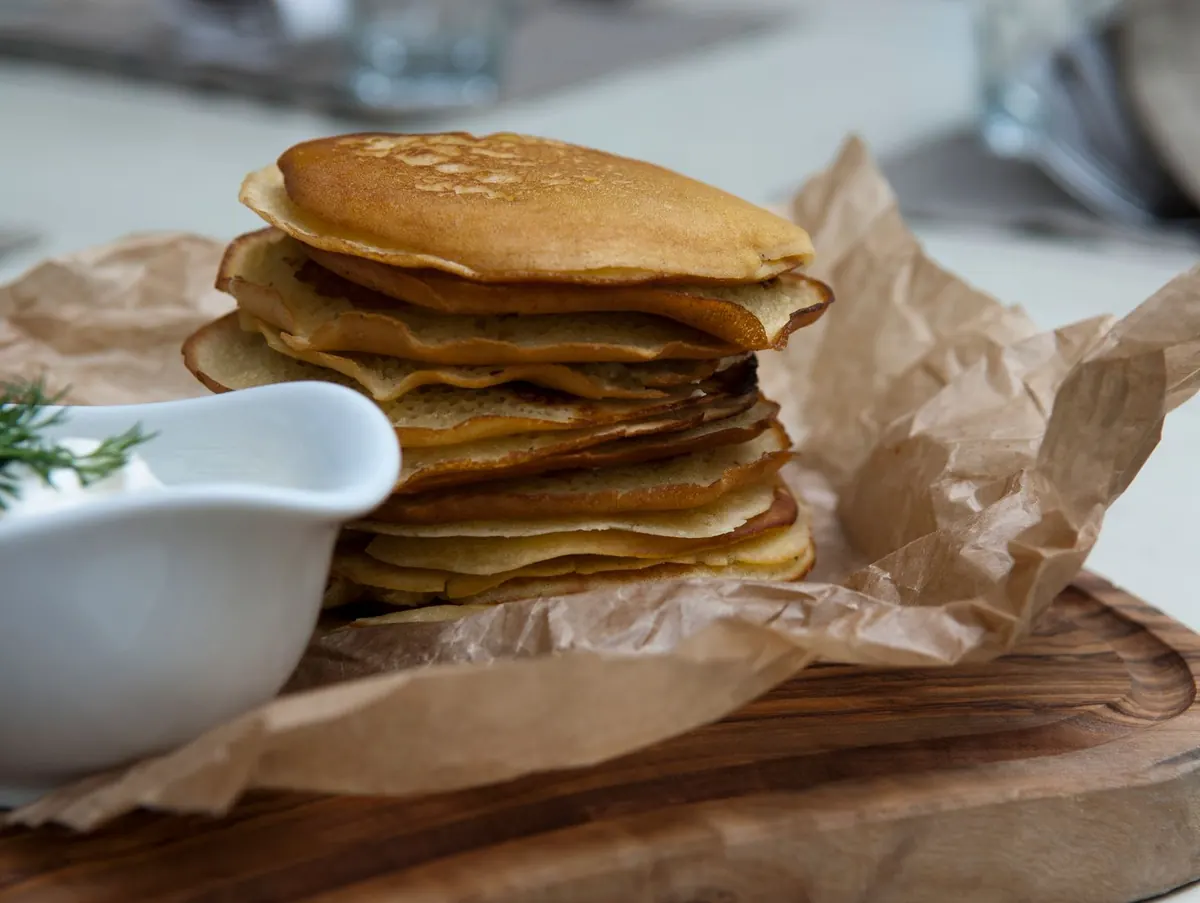
The Welsh crempog is the closest surviving cousin: a small, soft griddle cake, sometimes leavened with yeast, sometimes dropped with currants, and sometimes no thicker than a pancake. The word itself looks suspiciously like "crumpet", and the two may well be related. The other candidate is Middle English crompid, meaning curled or crumpled — a fair description of how a soft cake puckers at the rim as it sets on a hot stone.
Naming the Thing
The word "crumpet" was being written down by the seventeenth century, and the object it described was already a familiar kitchen item. Tudor and Stuart cooks worked at open hearths, with a griddle set on a trivet over the coals and rings — at first earthenware or bent metal — holding the batter in neat circles. Eighteenth-century cookery books printed crumpets and muffins side by side, treating them as siblings. They almost are: the same soft, yeasted mixture, handled two different ways.
The ring is the quiet hero here. A crumpet without one is a pikelet — thinner, wider, with a lacy edge — which is why the two names still collide in bakeries from Stoke to Swansea. The ring gives the batter somewhere to climb, and the sides of the ring hold the shape while the top sets into that familiar field of craters.
What Made the Holes
Everything about a good crumpet comes down to a batter that can bubble and a heat that lets it. The mixture is pourable, closer to double cream than to bread dough, so yeast and a little bicarbonate of soda can push gas up through it in steady streams. Cooked in a ring over moderate heat, the base sets first. The bubbles keep rising, reach the surface, swell, and burst — and because the crumpet is cooked on one side only, those burst bubbles stay open. That is the whole trick. Nothing is punctured afterwards, and nothing is turned to seal them in.
Bicarbonate of soda, once it became an ordinary household staple in the nineteenth century, made the rise more reliable and the crumb more even, and the modern crumpet is essentially a nineteenth-century product. The classic failure has not changed either: too hot a griddle gives a scorched base and a raw, gluey middle, while a batter that is too stiff rises into something closer to a muffin.
Regional Variations
Names for griddle cakes shift every thirty miles or so, and a crumpet in one county is something else entirely in the next. The main family tree runs roughly like this:
- Pikelets — the Midlands and the north of England. The same or a very similar batter, cooked free-form without rings, so they spread thinner and often get split and buttered like a roll.
- Welsh crempog — small griddle cakes, sometimes yeasted as crempog furum, sometimes sweetened and dotted with currants or dried fruit.
- Scottish griddle cakes and pancakes — flatter and often a touch sweeter, eaten at breakfast with butter and jam rather than as a tea-time item.
- English muffins — the same soft dough family, but cooked on both sides, dusted with flour and split rather than riddled with holes.
- Oatcakes — Staffordshire and Derbyshire share the griddle, not the batter. Oats, yeast and a long fermentation give a completely different, pliable cake.
Travel with the names and you will be corrected often. In parts of Wales a pikelet is simply a crumpet. In some Scottish bakeries, a crumpet is a sweet, flat thing closer to a drop scone. Anyone who claims a single correct definition has not eaten widely enough.
The Crumpet Man and the Tea Table
By the nineteenth century, crumpets had left the farmhouse hearth for the street. Muffin and crumpet men carried baskets or trays through the towns, announcing themselves with a bell or a call, and sold their wares warm for a penny or two. Households without a griddle bought them instead, then toasted them on a long fork in front of the fire until the top crackled and the butter ran into the holes.
Afternoon tea gave the crumpet its natural stage. The oft-told story is that Anna, Duchess of Bedford, began taking tea and cake in the afternoon in the 1840s, and the habit spread upward and outward from there. By the end of the century, tea was a proper meal with a fixed repertoire, and crumpets fitted perfectly: cheap, made in batches, robust enough to keep for a day, and improved by reheating. The toasting fork did the rest.
From Bakery Batches to the Kitchen Toaster
The twentieth century industrialised the whole business. Bakeries in Lancashire and Yorkshire turned out crumpets by the thousand, wrapped them in waxed paper, and later in plastic, and the electric toaster finished the job the fire had started. A food that once needed a griddle, a fire and an hour of patience became a fixture of the weekly shop.
The word wandered off on its own as well. By the 1960s "crumpet" had become a bit of British slang for an attractive person — a usage that now sounds dated and a little embarrassing, and which most bakers would rather not hear again. The cake has outlasted the joke.
Getting the Most from a Crumpet
All that history is pleasant, but the point of a crumpet is the eating, and there is a right way to do it. Treat these as rules rather than suggestions.
- Toast it properly — in a toaster or under a grill, holey side up, until the top is crisp and the edges have taken on real colour.
- Butter it the moment it comes out, and be generous. The holes are there to catch what melts.
- Eat it straight away. A crumpet goes leathery within minutes and never quite recovers.
- Skip the microwave. It steams the crumb into something rubbery and robs you of the crisp top. If a crumpet has dried out, sprinkle it with a little water and warm it in a low oven instead.
- Freeze the spares with a sheet of baking paper between them, and toast from frozen, adding a little extra time.
- Top with intent: Marmite, honey, jam, mature cheddar under the grill, a poached egg, or baked beans if you are making a proper plate of it.
Make your own and you learn why the griddle survived. Buy metal rings, keep the batter loose, work at a moderate heat and wait until the surface sets and the bubbles burst before you lift the ring. The first batch usually teaches more than any recipe can.
Photo: Hawksbill.24 / Pexels
Related posts
More stories you’ll love reading